
He’s 400 years old and only two-feet tall, but he’s the most recognizable resident of Europe’s central city, Brussels. He’s Manneken Pis, the little boy peeing, and countless travel articles and blog posts have been written about him, usually accompanied by the exact same photo. Rather than just share the (mostly) interesting history of this strange statue, I want to also discuss why he’s so revered and how his spirit, and the spirit of his dog and sister, really do serve as a perfect emblem for Brussels.
There are a lot of myths and legends associated with the boy statue/fountain and form along two clear lines: victory in battle and rebellious spirit. Some say that it represents a boy lord who vanquished his foes (well, his troops did) or a young boy who managed to save the city with his urination. The other line, rebellious kid, revolves around a parent losing track of their child and finding him in various areas around town peeing. His fame though most likely comes through a more prosaic chain of events. Since the fountain was a central water source for a few hundred years, generations of Belgians grew up “getting to know” Manneken Pis and his whimsical ways and he gradually found himself the star of several myths and legends.

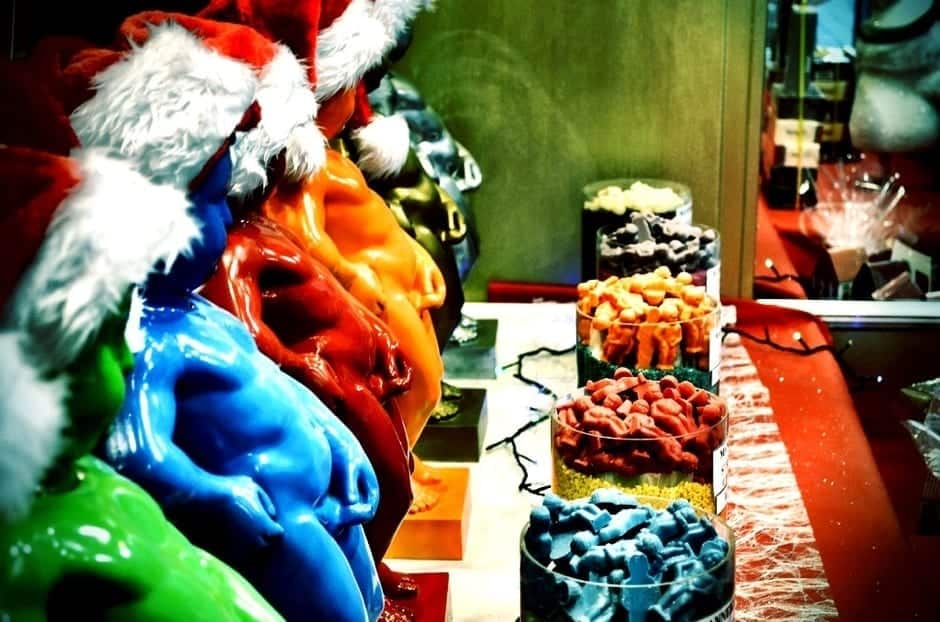
Today the statue is a major tourist site and ranks with The Little Mermaid statue in Copenhagen for being heavily visited, but somewhat pointless and not terribly interesting. Yet, every year millions of people trek past the Grand Place and down the Rue de l’Étuve to see this wildly inappropriate statue and to perhaps buy a Manneken Pis mug or chocolate statue. It’s not just the tourists fueling this lemming-like march to the peeing boy, local officials constantly dress up the tiny bronze piece (no pun intended, sorta) in a variety of costumes from Santa Claus at Christmas to a sparkly Elvis suit.
But why?
It’s not because it’s an amazing work of art, the statue on display isn’t ever the real one, it’s a replica. It’s not because it played a pivotal role in history or represents a dramatic moment in the timeline of Brussels. For once I think the tourism folks have it right when they say it’s because it symbolizes the rebellious spirit of Brussels. Now whether or not Brussels is really rebellious, I can’t say, but it’s a nice thought to rally around and in which to take pride. Which, as exemplified by the 800 little costumes Manneken Pis owns, is exactly what Brusselians (Brusselsites?) have done. They’re proud of the silly statue and as such have built it up into not just a quirky site, but one of the must-do activities in the city.

And if the best example of admiration is replication, then it’s well proven by the presence of Manneken Pis’ extended family, dog and girl peeing. Yup, that’s right, a couple of enterprising, and slightly sarcastic sculptors, have created a dog and sister, both peeing, to accompany Manneken in other parts of the city.
So instead of skipping the statue or scoffing at it as a tourist trap, go and see it and understand the quirky spirit that is really at the core of Belgium, more than any beer, waffle or piece of chocolate could ever be.

When I eventually make it there one day I’ll be sure to send you a tweet! :)
Thanks for the tip. Will definitely take a pic of Mannekin Pis when I arrive in Brussels on Monday :)
The main reason for visiting Manneken Pis is that it is very close to Grand Place. Also if you are sampling some of the more well know bars in Brussels you might pass it. In a country that not only has around 800 beers, but actually drinks beer regularly perhaps peeing statues have another meaning? Jeanneke Pis is opposite Delirium a drinking establishment boasting over 4000 beers from around the world, manages to stick a bar towel for Brains beer on the ceiling back to front, but does not offer even one Welsh Beer!
The Bruxellois even made the wall of St Catherine’s Church a urinal! Fortunately it has been closed as part of the renovation works. I don’t think it will reopen, or at least I hope it doesn’t.
I’ve been to visit Manneken Pis many, many times since I was a child. I love his story!
I totally bought a mini-bronze statue to bring home.
I didn’t know it was a replica! Ha! Nor about his sister somewhere in the city!
I have made the trek to find him. Just one of those quirky things you can see when you travel. Love that weird stuff! Ha!
I have visited Manneken Pis only once, a couple of years back and wasn’t really informed on any of the story. All I knew was the image, and the fact that it was THE thing to see in Brussels. We wandered around the city trying to find it (imagining it was much bigger) and we almost walked past it, until we saw a group of tourists looking at something. We turned around and there it was. We were obviously very dissappointed. It was so TINY. Now I know that disappointment in travel usually comes from too high or wrong expectations, so I’m sure that when I visit it a second time I’ll like it better :)